Ahead of the Eurogroup's next meeting on Monday, it is still up in the air whether Greece will get a second rescue package. Fears remain that Greec could declare insolvency.
Finance ministers of eurozone countries are meeting on Monday in Brussels to discuss the way forward for Greece. The focus will be on whether to approve a second rescue package worth 130 million euros.
The head of the Eurogroup, Luxembourg's Prime Minister Jean-Claude Juncker, has expressed confidence that the body will reach agreement on essential features of the rescue package on Monday. Rome shared the same view in a conference call between Italian Prime Minister Mario Monti, Greek Prime Minister Lucas Papademos and German Chancellor Angela Merkel.
On her official website Saturday, Merkel tried to put a positive spin on other European countries' disagreements over Greece. She compared European politics to German domestic politics, saying both see strong arguments over the right way forward. But she added that even when debating, eurozone leaders do so with the best intentions toward Europe.
Internal dispute

Juncker will oversee a crucial meeting Monday
The question whether Greece can be saved or not is fuelling debate across Europe. German Finance Minister Wolfgang Schäuble recently raised his own doubts on the subject, saying eurozone countries could not pour their aid into a bottomless pit.
After that, Merkel's spokesman Steffen Seibert on Friday made a point of saying the chancellor and Schäuble were on the same page regarding Greece.
French Prime Minister Francois Fillon warned against speculation Greece could go bankrupt.
"That would be dramatic for Greeks themselves and dramatic for Europeans," he said.
Fillon added that everything possible must be done to prevent Greek insolvency.
Greek efforts
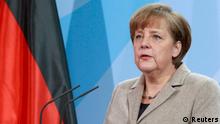
Merkel played down differences of opinion over Greece
The Greek government held a special cabinet meeting on Saturday to discuss possible obstacles to a second aid package. One issue is how to cut an extra 325 million euros from its budget this year. That's the amount by which Greece still falls short of the 3.3 billion euros the eurozone is demanding in cuts before the group will authorize further aid. The remaining millions are expected to come from cuts in state pensions.
Right now, the fear of going bankrupt, and the possible consequences, seems to outweigh Greek leaders' political considerations. According to an analysis of the so-called troika of the European Commission, the International Monetary Fund (IMF) and the European Central Bank (ECB), the Greek savings plans proposed to date are not enough to lastingly lower Greece's debt level.
It is also unclear whether Greece's private creditors will voluntarily trim Greece's debt by 100 million euros. The IMF, which represents private financial institutions, is yet to officially give its opinion.
Ahead of Monday's decisive eurozone ministers' meeting in Brussels, the ECB remains worried. The body is afraid that if Greece's creditors do not voluntarily forgive the country its debts, the Greek government could pass a law to convert its debt. With a compromise, the ECB would protect itself against billions in losses.
Author: Rachel Gessat/srs
Editor: Andreas Illmer dw de
Editor: Andreas Illmer dw de

Comments