Paris attacks: Key questions after Abaaoud killed
Paris attacks: Key questions after Abaaoud killed
- 3 hours ago
- Europe
 AFP
AFP
France and neighbouring countries are on high alert after the Paris attacks, which killed 129 people and wounded hundreds more.
President Francois Hollande says France is "at war" with so-called Islamic State (IS).
Here we look at the international impact of the attacks and the lessons the authorities are trying to draw from it.

Are the attacks over?
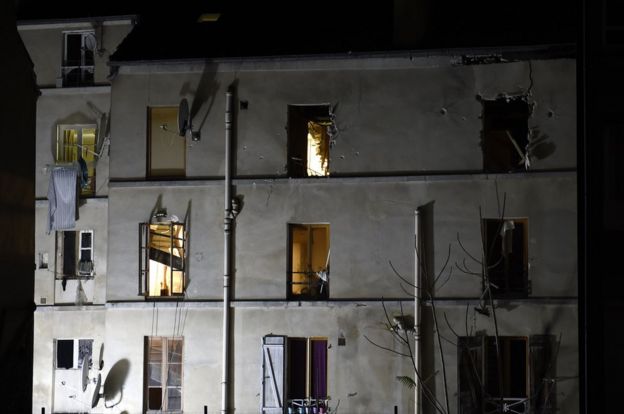
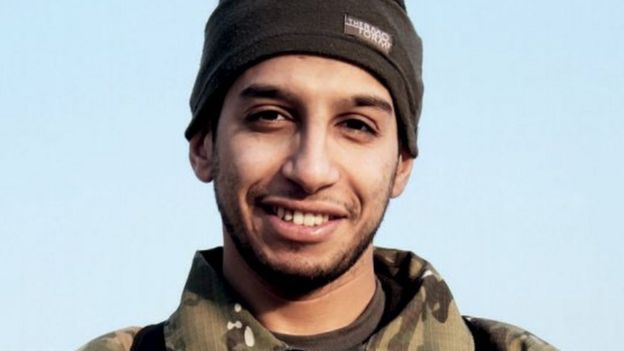
It is too early to say. But there was a breakthrough on Thursday - it was confirmed that the suspected ringleader, IS militant Abdelhamid Abaaoud, was killed in a police raid in Saint-Denis, northern Paris.
His fingerprints were formally identified from remains found in a Saint-Denis apartment, where a group of militants fiercely resisted anti-terror police early on Wednesday.
France is urgently hunting another leading suspect - Salah Abdeslam, who hired one of the cars used in the attacks. Salah's brother Brahim blew himself up in Boulevard Voltaire during Friday's attacks.
French media have reported that nine militants carried out the attacks, and we know that seven died on Friday night. So it is possible that another attacker - as well as Salah Abdeslam - is still at large.
 AFP
AFP
There has also been speculation that the militants killed and detained in Saint-Denis with Abdelhamid Abaaoud were planning to attack La Defense - an upmarket Paris business district - and Paris Charles de Gaulle airport, though no evidence has been provided.
Two men were arrested in the apartment in Saint-Denis and six other people nearby, so police may get some key information from them.
How was the plot hatched?
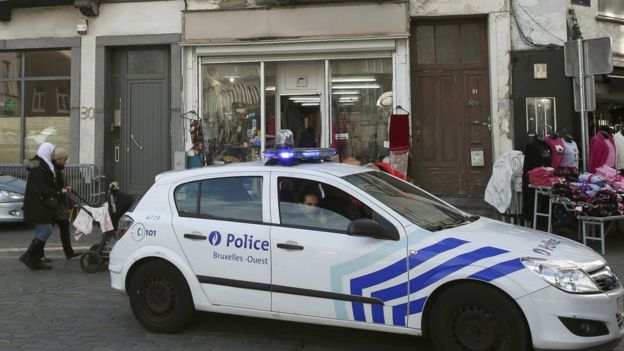
French authorities believe that IS in Syria decided to launch the attacks, and that the operation was planned in Belgium, probably in Molenbeek, a Brussels district known for high unemployment, social problems and a mixed immigrant population.
IS said its militants had attacked Paris in order to punish "crusader" France for its air strikes against "Muslims in the lands of the Caliphate" - their language for Iraq and Syria.
The attack "targeted the capital of prostitution and obscenity, the carrier of the banner of the Cross in Europe: Paris," IS said.
Many Molenbeek residents are Arabs, and jihadists have long been linked to the area.
On Thursday, Belgian police arrested nine suspects near Brussels, including seven said to have known Bilal Hadfi, one of the suicide bombers.
At least three cars hired in Belgium were used in the attacks: a black Seat, a black VW Polo and a VW Golf.
Investigators suspect the gunmen used safe houses in Saint-Denis, Bobigny and Alfortville in the Paris region.
But it is not clear when the group met up to launch the attacks. Other elements of the plot also remain unclear.
Investigators will be studying phone records and assessing the weapons seized for further clues.
Paris attacks and police raids
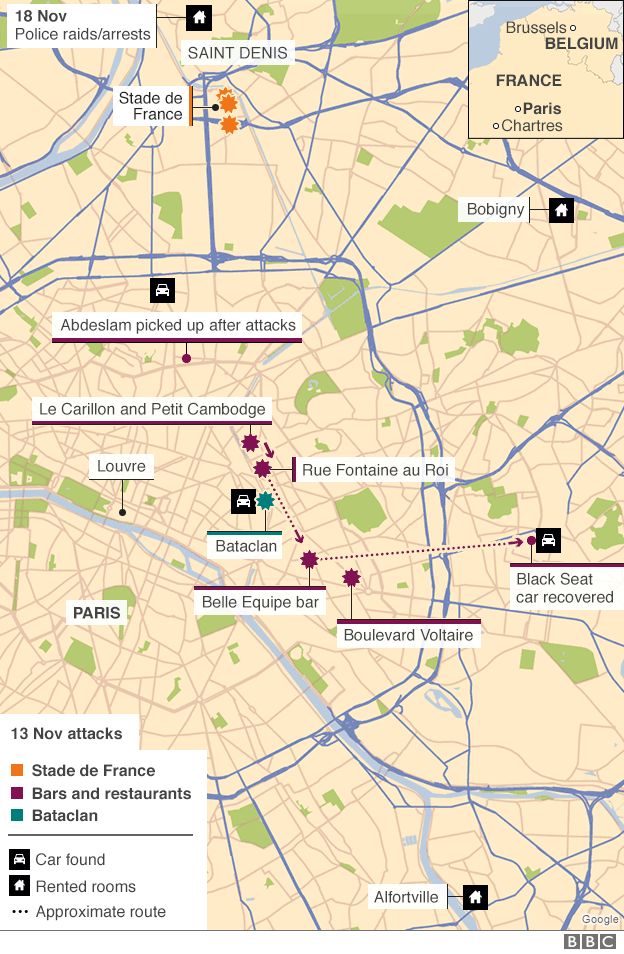
Investigators believe there were three well-organised, tightly co-ordinated groups of militants involved in the 13 November attack. They used Kalashnikov assault rifles and explosive belts.
The militants - four of them French citizens - struck at three main locations: outside the Stade de France and, in central Paris, crowded bars and restaurants and the Bataclan concert hall.
Three detonated their suicide belts near the stadium, during a high profile France v Germany football match. They may have planned to get inside the stadium but been frustrated.
Bataclan was the bloodiest scene - 89 people died there.
The attacks probably required months of training, said Pieter Van Ostaeyen, a Belgian expert on Islamist extremists.
The plan was evidently designed to kill many people randomly - they targeted crowded places, where young people were having fun.
Why weren't the attackers stopped?
France's security services and its European partners will be scrutinised as to whether they should have picked up intelligence about the attacks, and stopped them.
For example, two Belgian IS fighters had warned in a video in February that they would attack France, Mr Van Ostaeyen told the BBC.
And security was stepped up in France after the January Islamist attacks in Paris on Charlie Hebdo magazine staff, a policewoman and a Jewish supermarket. Three gunmen killed 17 people before being shot dead by police.
But security experts say it is very difficult to prevent attacks like the latest Paris one, involving groups of suicidal gunmen with bombs hitting soft targets indiscriminately and simultaneously.
There is surveillance of known jihadists' communications - whether via mobile phone or the internet - but increasingly widely available strong encryption makes that more difficult.
 Reuters
There is intense pressure in France and Belgium now to tighten monitoring of suspected jihadists, because some of the attackers had spent time in Syria with IS jihadists.
Among the proposals are: jail or house arrest for jihadists who return from Syria; stripping violent jihadists of their citizenship; putting electronic tags on suspects.
Some critics also say it is far too easy for jihadists to cross borders in the EU's passport-free Schengen zone. Only now are vehicles being routinely checked at the Belgium-France border.
More intelligence-sharing between French and Belgian anti-terrorist police might have alerted them to the imminent threat to Paris.
How significant is the Belgian connection?
Very - Molenbeek was apparently the operational nerve centre, but there were some other Belgian connections.
Abaaoud boasted of having helped set up an IS cell in Verviers, eastern Belgium. Police raided a safe house there in January, killing two jihadists, but he got away.
Belgian ministers admit that more should have been done to tackle Islamist extremism in Molenbeek.
 Reuters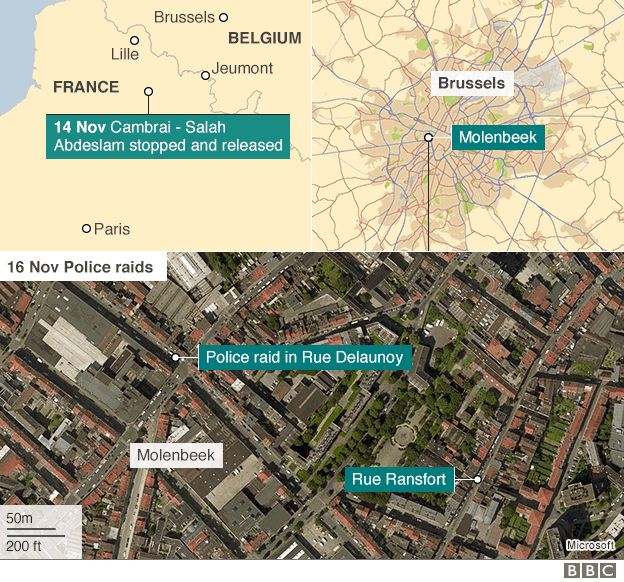
Mehdi Nemmouche, a Franco-Algerian jihadist accused of murdering four people at the Jewish Museum in Brussels in May 2014, had also spent time in Molenbeek.
More jihadists have gone from Belgium to join IS in Syria and Iraq than from any other EU country, per capita.
Belgium - highly federalised - has various police forces, so sometimes co-ordination is a problem.
Sometimes key intelligence is not passed on - not only inside Belgium but also to EU partners such as France, says Dutch expert Liesbeth van der Heide, of Leiden University's Centre for Terrorism and Counterterrorism.
The EU does not have a central database for specific intelligence on jihadists - but there are calls for that now.
Has Europe lost control of its borders?
The Paris bloodshed has fuelled concerns about Schengen and the EU's external borders.
Freedom of movement is a cherished core value of the EU - but it means that violent jihadists and other criminals can also cross borders easily, after entering the EU.
Schengen exists in a Europe where national authorities still jealously guard intelligence that affects their country's security.
 AP
AP
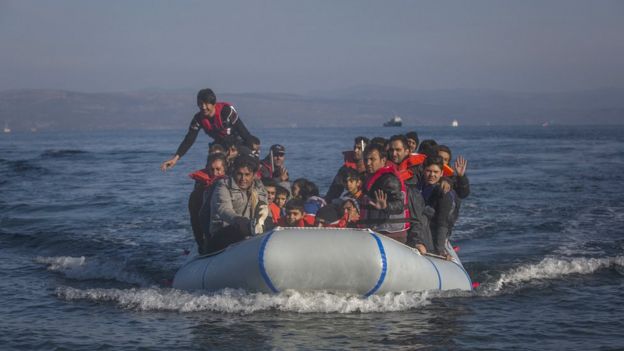
As for the EU's external borders, the influx of migrants - many of them Syrian refugees - has put them under severe pressure this year.
Greece and Italy, with long sea borders to patrol, are getting help from the EU to screen arriving migrants. But it is not enough.
More than 650,000 migrants have reached Europe's shores this year. There are fears that some jihadists have slipped through in the crowds.
One of the Paris suicide bombers had a fake Syrian passport in the name of "Ahmad al-Mohammed". Greek officials said someone with that passport had been registered last month on the island of Leros.
Will there be a repeat of the Paris attacks in France or elsewhere?
Security is now extremely tight across France. Under the existing state of emergency, French police have greater powers to search premises and detain suspects.
But France's interior minister, Bernard Cazeneuve, has warned that EU nations need to tighten checks at external borders.
"It is urgent that Europe gets its acts together, organises itself, defends itself against the terrorist threat," he said.
France has also hit back, bombing IS militants in Syria and Iraq. The US and its allies, as well as Russia, are also attacking IS to varying degrees.
So the risk of IS trying to carry out more attacks, inside Europe or elsewhere, remains real.
France has warned that IS might use a chemical or biological weapon in a future attack. French emergency teams are to be supplied with atropine sulfate, an antidote to nerve gas.


Comments