Migrant crisis: Turkey and Greece to discuss deal as influx continues
Migrant crisis: Turkey and Greece to discuss deal as influx continues
- 4 hours ago
- Europe
Officials from Turkey and Greece are set to discuss how to implement last week's deal on migrant repatriation.
Under the agreement between the EU and Turkey, migrants arriving in Greece are now expected to be sent back to Turkey if they do not apply for asylum or their claim is rejected.
But Greece still lacks the manpower to process all the new asylum-seekers.
Some 875 migrants arrived in Greece overnight Saturday to Sunday as the deal came into effect.
They are expected to be transferred to temporary camps on the mainland.
Authorities will discuss the deal which says that for every Syrian migrant sent back to Turkey, one Syrian already in Turkey will be resettled in the EU.
But questions remain over some points, including how the migrants will be sent back or what will happen to those thousands of people already in Greece. Officials have said the returns to Turkey are unlikely to start before 4 April.
Additionally, some 2,300 experts, including security and migration officials and translators, are yet to arrive in Greece to help enforce the plan.
"[The deal] is in force. Its practical implementation remains to be seen," government migration spokesman Giorgos Kyritsis was quoted by AP as saying.
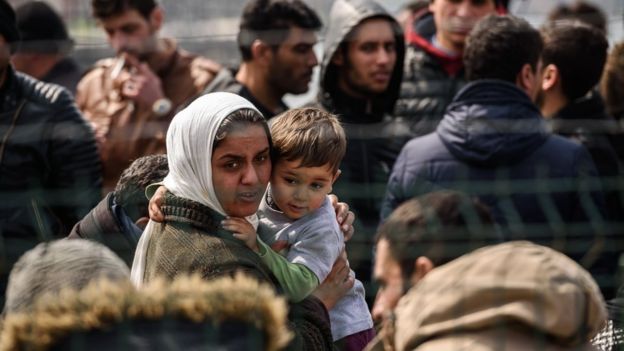
Meanwhile, tens of thousands of migrants are still stuck in Greece and on its closed border with Macedonia as their route north has been blocked.
Key points from the agreement
 AFP
AFP- Returns: All "irregular migrants" crossing from Turkey into Greece from 20 March will be sent back. Each arrival will be individually assessed by the Greek authorities.
- One-for-one: For each Syrian returned to Turkey, a Syrian migrant will be resettled in the EU. Priority will be given to those who have not tried to illegally enter the EU and the number is capped at 72,000.
- Visa restrictions: Turkish nationals should have access to the Schengen passport-free zone by June. This will not apply to non-Schengen countries like Britain.
- Financial aid: The EU is to speed up the allocation of €3bn ($3.3 bn; £2.3 bn) in aid to Turkey to help migrants.
- Turkey EU membership: Both sides agreed to "re-energise" Turkey's bid to join the European bloc, with talks due by July.
With the deal, it is hoped people will be discouraged from making the dangerous journey by sea from Turkey to Greece. In return, Turkey will receive aid and political concessions.
Since January 2015, one million migrants and refugees have entered the EU by boat from Turkey to Greece. More than 143,000 have arrived this year alone, and about 460 have died, according to the International Organization for Migration.
Critics, however, have said the deal could force migrants to start using other and potentially more dangerous routes, such as the journey between North Africa and Italy.
In the hours before the plan came into force, hundreds of people were rescued by Italian and Libyan officials amid an increase in traffic through the Strait of Sicily.
And in Turkey, at least 200 people were caught in a coastal town and turned back as they tried to reach Greece ahead of the deadline, authorities said.
 Getty Images
 AFP
AFP
Human rights groups have strongly criticised the deal, with Amnesty International accusing the EU of turning "its back on a global refugee crisis".
Most of the migrants arriving in Europe are keen to go to Germany and other northern countries, which have seen increasing public discontent with the high influx.
Meanwhile, Bavarian finance minister Markus Soeder - a member of the sister party of German Chancellor Angela Merkel's CDU, the Christian Social Union - has said the deal could lead to a mass migration of Kurds to Germany, as the agreement gives Turks visa-free travel rights.
"It could ultimately lead to more immigration, especially if you take visa freedom into account. Many, many Kurds fleeing the Turkish government could come to Germany," Mr Soeder told German public broadcaster ZDF.


Comments