European Union | 30.08.2007
EU Plans Natural Disaster Response Units
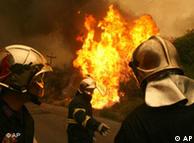
The European Union is considering setting up permanent reaction teams to better deal with natural disasters like the current devastating forest fires in Greece, which have killed at least 63 people.
EU Environment spokesperson Barbara Helfferich said the European Commission had started developing the idea of setting up response units, and hoped to present plans later this year.
These civil protection units would consist of readily-deployable, highly-trained personnel backed up with specialized equipment. One of the so-called "response modules" already identified as a key need is a forest fire-fighting unit.
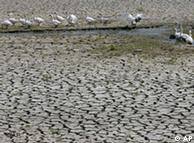 Bildunterschrift: Großansicht des Bildes mit der Bildunterschrift: There have been a series of disasters this summer
"The costs of not doing enough in a coordinated way far outweigh the costs of doing it... in a coordinated, better way," said Helfferich.
The European Commission has been coordinating the response to the Greek forest fires through its Brussels-based Monitoring and Information Centre (MIC).
Last Friday, Greece asked its European partners to provide water-bombing aircraft to help fight the fires which have been affecting the country since the beginning of the summer but have dramatically increased in intensity in the past six days.
Massive coordination effort
The MIC co-ordination of the Greece crisis is, according to Helfferich, its "biggest effort ever" since the center was set up in 2001. Nine member states responded to Greece's calls for help.
The Commission on Wednesday confirmed that Greece intends to ask for financial support from the EU's solidarity fund in the wake of the forest fires. It can take up to eight months, however, for the funds to be released, a spokesperson said.
The solidarity fund was established in 2002 to support EU members who have suffered from natural disasters. A country can ask for its help when the damage from a disaster exceeds 0.6 per cent of gross national income, or 1.1 billion euro ($1.45 billion) in the case of Greece.
Thousands of people rushed to banks to claim a 3,000 euro initial Greek government compensation handout.
Fires easing
Meanwhile, Greek firefighters indicated that the battle against the fires was being won.
"At the moment no populated areas are under threat," fire service spokesman Nikos Diamantis said at a press conference on Wednesday, adding that while the fires had eased somewhat, it was still too early for the all-clear to be issued.
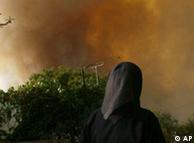 Bildunterschrift: EU states have sent aircraft and firefights to help
Fires were still burning in 29 regions on the Peloponnese peninsula and the island of Euboea, compared to 36 the previous day, but better weather has helped crews stop the fires from spreading rapidly through parched forests
Some 110 villages are estimated to have been wholly or partially burnt. The flames have also destroyed 4.5 million olive trees, and 60,000 sheep and goats have died.
There has been widespread criticism of the Greek government's handling of the fires, which many believe were started by arsonists on behalf of property developers.


Comments